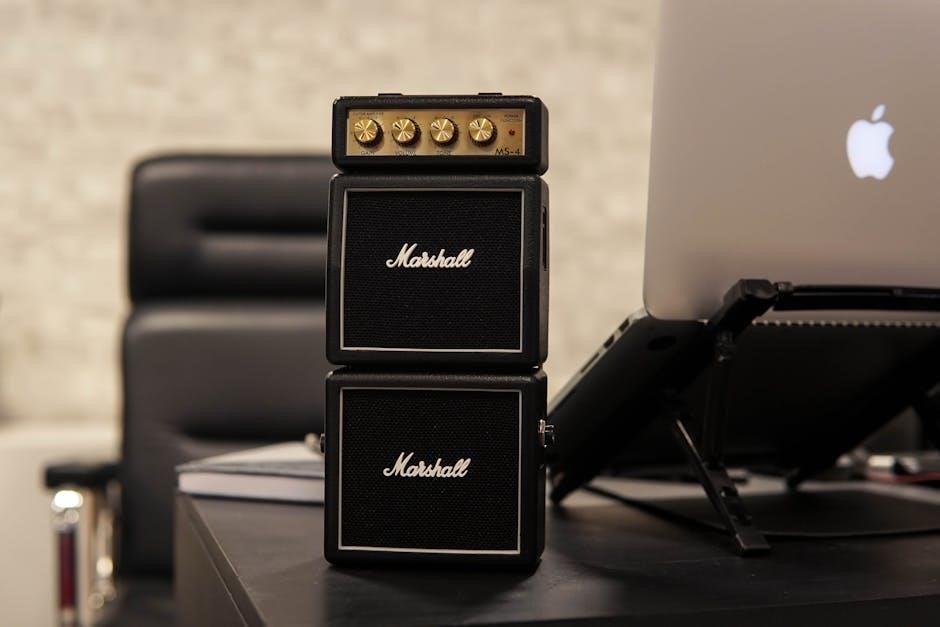
Marshall Code 50 Manual: A Comprehensive Guide
This guide offers detailed instructions for the Marshall Code 50, covering setup, features, troubleshooting, and customization – ensuring optimal performance and enjoyment.
The Marshall Code 50 is a versatile, digital modeling amplifier designed for guitarists seeking a wide range of tones and convenient features. It bridges the gap between classic Marshall sound and modern digital technology, offering everything from pristine cleans to high-gain distortion; This amplifier caters to players of all levels, from beginners exploring different sounds to experienced professionals needing a reliable and flexible rig.

Featuring a user-friendly interface and powerful software integration, the Code 50 allows for extensive customization and preset creation. It’s built to be both stage-ready and ideal for home practice, providing a comprehensive solution for any guitarist’s needs. Explore its diverse voices and effects to unlock your sonic potential!
Unboxing and Initial Setup
Upon unboxing your Marshall Code 50, carefully inspect the contents for any damage sustained during shipping. You should find the amplifier itself, a power cable, and this user manual. Before connecting the amplifier, ensure your local voltage matches the amplifier’s power requirements. Connect the power cable to the amplifier and a grounded outlet.
Next, connect your guitar to the input jack. Begin with the volume and gain knobs at a low setting. Connect a speaker cabinet to the appropriate output jack, ensuring correct impedance matching (refer to the specifications section). Power on the amplifier and gradually increase the volume to a comfortable level. You are now ready to explore the initial settings and begin your tonal journey!
Understanding the Control Panel
The Marshall Code 50’s control panel is logically organized for intuitive operation. The Gain knob adjusts the preamp’s input level, influencing distortion. Treble, Middle, and Bass controls shape the tonal character. The Master Volume controls the overall output level. Selectable Power Reduction switches offer options for lower wattage operation.
The Voice selector provides access to a range of pre-voiced amp models. The Modulation, Delay, and Reverb sections control the digital effects. Dedicated knobs adjust the depth and intensity of each effect. The Preset buttons allow quick access to saved tones, while the Save button stores custom settings. A comprehensive LCD screen displays current settings and facilitates navigation.

Amplifier Sections & Features
Explore the core components: preamp for tone shaping, power amp for wattage control, and versatile digital effects – all defining the Code 50’s sonic capabilities.
Preamp Section: Gain and Tone Shaping
The preamp section is the heart of your tone, controlling the initial amplification and character of your signal. Marshall Code 50 offers a diverse range of preamp voicings, emulating classic Marshall amps and beyond. The ‘Gain’ control adjusts the input sensitivity, impacting distortion levels – from clean boosts to high-gain leads.
Tone shaping is achieved through the three-band EQ (Bass, Middle, Treble), allowing precise frequency adjustments. Experiment with these controls to sculpt your sound, emphasizing specific frequencies or cutting unwanted ones. The ‘Shift’ button alters the mid-frequency center, offering further tonal flexibility.
Additionally, the preamp section interacts seamlessly with the digital effects, allowing you to layer modulation, delay, and reverb before the signal reaches the power amp, creating complex and dynamic sounds. Mastering the preamp section unlocks the full potential of the Code 50.
Power Amp Section: Wattage Selection
The power amp section of the Marshall Code 50 emulates the characteristics of various power amp configurations, offering selectable wattage options. This feature allows you to tailor the amp’s response to different playing environments and speaker cabinets. Choices typically include 50W, 20W, and 5W settings, simulating the tonal differences between them.
Lower wattage settings introduce earlier breakup and a more compressed sound, ideal for home practice or smaller venues. Higher wattage settings provide more headroom and clarity, suitable for larger stages and louder performances. The wattage selection significantly impacts the dynamic range and overall feel of the amplifier.
Experimenting with these settings is crucial to finding the sweet spot for your playing style and desired tone. Remember that lower wattage doesn’t necessarily mean quieter; it alters the amp’s responsiveness.
Digital Effects: Modulation, Delay, and Reverb
The Marshall Code 50 boasts a comprehensive suite of digital effects, categorized into modulation, delay, and reverb. Modulation effects, such as chorus, flanger, and phaser, add movement and texture to your sound. Delay provides echoes, ranging from subtle slapback to long, ambient repeats, enhancing spaciousness.
Reverb emulates acoustic spaces, from spring reverb’s twang to hall reverb’s grandeur, adding depth and dimension. Each effect category offers multiple variations, allowing for extensive tonal shaping. Effects can be engaged individually or combined to create complex soundscapes.
Parameter control allows adjustment of depth, rate, time, and level, tailoring each effect to your preference. The quality of these digital effects rivals dedicated pedalboards, offering versatility within a single unit.
Voice Settings: Exploring the Presets
The Marshall Code 50 features a diverse range of pre-programmed “Voice” settings, designed to replicate iconic Marshall amp tones and explore new sonic territories. These presets cover various genres, including clean, crunch, overdrive, and high-gain, providing a starting point for any guitarist.
Each Voice combines preamp characteristics, power amp settings, and digital effects, offering a complete and ready-to-play sound. Exploring these presets is an excellent way to understand the amplifier’s capabilities and discover inspiring tones;
Presets are categorized for easy navigation, and users can easily modify existing presets or create entirely new ones. The Voice settings serve as a foundation for customization, allowing players to dial in their signature sounds quickly and efficiently.

Connectivity and External Controls
Explore versatile connections like footswitches, USB, auxiliary inputs, and headphone outputs, enhancing control and integration with external gear and software.
Footswitch Control: Channel and Effects Switching
The Marshall Code 50 offers extensive footswitch control for seamless performance transitions. Utilizing the dedicated footswitch input, you can navigate between channels – effortlessly switching between clean, crunch, lead, and acoustic voices – directly from stage or practice. Beyond channel selection, the footswitch enables on/off control of the digital effects section.
This allows for real-time manipulation of modulation, delay, and reverb, adding dynamic textures to your playing without interrupting your flow. Customization is key; the Code 50 allows you to program the footswitch to control specific effects parameters, tailoring the response to your individual needs. Proper footswitch assignment is configured through the Marshall Gateway software, providing a user-friendly interface for detailed control.
USB Connectivity: Firmware Updates and Software Editing
The Marshall Code 50 boasts USB connectivity, serving a dual purpose of firmware updates and in-depth software editing. Connecting the amplifier to your computer via USB allows you to ensure your Code 50 is running the latest software, benefiting from bug fixes, performance enhancements, and potentially new features.
More importantly, the USB connection unlocks the power of the Marshall Gateway software. This software provides a visual interface for creating, editing, and managing presets with granular control over every amplifier and effect parameter. You can also back up and restore your custom tones, share them with other users, and explore a library of presets created by the Marshall community.
Auxiliary Input and Headphone Output
The Marshall Code 50 provides convenient options for practice and playback with its auxiliary input and headphone output. The 3.5mm auxiliary input allows you to connect external audio sources, such as smartphones, tablets, or MP3 players, enabling you to play along with backing tracks or your favorite songs. This is ideal for jamming or learning new material.
For silent practice or late-night sessions, the built-in headphone output delivers a clear and direct audio signal, eliminating the need for external speakers. This feature is crucial for maintaining respectful volume levels and focusing on your playing. Both inputs are conveniently located on the amplifier’s rear panel for easy access.
Speaker Outputs: Impedance Matching
The Marshall Code 50 offers versatile speaker connectivity with multiple impedance options, ensuring optimal performance with various cabinet configurations. It features outputs for 8 and 16-ohm speaker cabinets, allowing you to match the amplifier’s impedance to your chosen speakers for maximum power transfer and sonic clarity.
Proper impedance matching is crucial to prevent damage to the amplifier and speakers, and to achieve the best possible tone. Always refer to the speaker cabinet’s specifications to determine its impedance before connecting it to the Code 50. Using an incorrect impedance can result in reduced volume, distorted sound, or even amplifier failure. The rear panel clearly labels the available impedance settings.

Advanced Features & Customization
Unlock the full potential of your Code 50 with custom presets, software editing, noise gate control, and detailed EQ adjustments for personalized tones.
Creating and Saving Custom Presets
The Marshall Code 50 truly shines when you begin crafting your own unique sounds. Experiment with the preamp gain, EQ settings, and digital effects to sculpt the perfect tone for any genre. Once you’ve dialed in a sound you love, saving it as a custom preset is straightforward.
Utilize the ‘Save’ button on the control panel, selecting an available preset slot. Remember to give your preset a descriptive name for easy recall. You can overwrite existing presets or save to an empty slot.
Furthermore, the ability to store numerous presets allows for quick access to a diverse range of tones during live performances or recording sessions. Regularly backing up your presets via the Marshall Gateway software is highly recommended to prevent loss of your creations.
Using the Marshall Gateway Software
The Marshall Gateway software expands the capabilities of your Code 50 significantly. Downloadable from the official Marshall website, this software provides a user-friendly interface for deeper editing and preset management. Connect your amplifier to your computer via USB to unlock its full potential.
Within the software, you can visually adjust parameters, create and organize presets, and even share your creations with other Code 50 users. Firmware updates are also delivered through the Gateway, ensuring your amplifier always has the latest features and bug fixes.
Importantly, the software offers a more precise level of control compared to the front panel knobs, allowing for nuanced tone shaping. Regularly check for software updates to benefit from ongoing improvements and new functionalities.

Noise Gate and Boost Functions
The Marshall Code 50 incorporates both a noise gate and a boost function to refine your sound. The noise gate effectively eliminates unwanted hum and hiss, particularly noticeable during high-gain settings, resulting in a cleaner, more professional tone. Adjust the threshold to find the sweet spot – suppressing noise without cutting off sustain.
Conversely, the boost function provides an instant volume increase, perfect for solos or emphasizing specific passages. It can be activated via footswitch for convenient on-the-fly control. Experiment with the boost level to achieve the desired impact, from subtle enhancement to a dramatic surge in volume.
Combining these features allows for dynamic control, ensuring clarity and impactful moments within your playing.
EQ Controls: Detailed Frequency Adjustment
The Marshall Code 50 features a comprehensive equalization (EQ) section, allowing precise tonal shaping. The three-band EQ – Bass, Middle, and Treble – provides broad frequency control, while the shift button alters the mid-frequency center point. This shift offers access to different tonal characteristics, from scooped mids for modern metal to pronounced mids for classic rock.
Further refinement is possible through the parametric EQ within the Marshall Gateway software. This allows for detailed adjustment of specific frequencies, enabling you to sculpt your sound with surgical precision. Experiment with boosting or cutting frequencies to eliminate unwanted resonances or enhance desired tones.
Mastering the EQ is crucial for achieving a polished and professional sound.

Troubleshooting & Maintenance
This section details solutions for common issues, firmware updates, and basic care to keep your Marshall Code 50 functioning optimally for years to come.
Common Issues and Solutions
Experiencing no sound? First, verify the power connection and speaker cable integrity. Ensure the volume knob isn’t at zero and the correct input is selected. If using headphones, check their connection. Preset issues? Try resetting to factory defaults via the menu.
Digital noise or glitches? A firmware update via the Marshall Gateway software often resolves these. Footswitch unresponsive? Confirm proper connection and assigned function within the settings. USB connectivity problems? Ensure the correct drivers are installed on your computer.
If the amp freezes, a power cycle (turning it off and on) usually fixes it. For persistent problems, consult the official Marshall support website for detailed troubleshooting guides and FAQs. Remember to always back up your custom presets before performing a factory reset or firmware update.
Firmware Update Procedures
Updating your Marshall Code 50’s firmware is crucial for optimal performance and access to new features. Download the latest firmware file from the official Marshall website. Ensure a stable USB connection between your computer and the amplifier. Launch the Marshall Gateway software and follow the on-screen prompts.
Before initiating the update, back up all custom presets to avoid data loss. The software will guide you through the flashing process; do not interrupt the update, as this could damage the amplifier. A progress bar will indicate completion.
Upon successful completion, the amplifier may restart automatically. Verify the new firmware version in the settings menu. Regularly checking for updates ensures your Code 50 remains current and functions flawlessly.
Tube Care and Replacement (if applicable)
The Marshall Code 50 is a solid-state amplifier and, therefore, does not utilize traditional vacuum tubes. This eliminates the need for tube replacement and associated care procedures like biasing or regular tube testing. However, internal components still require careful handling.
While tube-related maintenance isn’t necessary, it’s vital to protect the amplifier from dust and extreme temperatures. Avoid exposing it to moisture or direct sunlight for prolonged periods. If you experience any internal component failures, contact Marshall support or a qualified technician.
Attempting self-repair without proper knowledge could void your warranty and potentially damage the amplifier. Routine cleaning with a soft, dry cloth is recommended to maintain its appearance and functionality.
Safety Precautions and Warnings
Always ensure the amplifier is properly grounded to prevent electrical shock. Never operate the unit with a damaged power cord or plug. Avoid opening the chassis as high voltages are present inside, even when powered off – servicing should only be performed by qualified personnel.
Keep the amplifier away from flammable materials and ensure adequate ventilation to prevent overheating. Do not expose the unit to rain or moisture. Prolonged exposure to loud volumes can cause hearing damage; always use appropriate hearing protection.
Disconnect the power cord before cleaning or performing any maintenance. Use a soft, dry cloth for cleaning. Improper use can lead to damage or injury – read all instructions carefully before operation.

Specifications and Technical Details
This section details the Marshall Code 50’s power needs, dimensions, speaker options, frequency response, total harmonic distortion, and comprehensive warranty information.
Power Requirements and Dimensions
The Marshall Code 50 operates on a universal power supply, accepting inputs from 100V to 240V at 50/60Hz, making it globally adaptable for various electrical standards. This ensures reliable performance regardless of your location. Its power consumption is rated at 60W, typical for a modeling amplifier of this caliber.
Regarding physical dimensions, the amplifier measures approximately 24.41 inches (620mm) in width, 17.32 inches (440mm) in depth, and 9.06 inches (230mm) in height. The weight is around 19.84 pounds (9kg), providing a solid and stable feel without being excessively heavy for transport or placement. These dimensions are designed for practical stage use and home studio integration, offering a balance between power and portability.
Speaker Configuration Options
The Marshall Code 50 boasts versatile speaker connectivity, featuring two 1/4″ speaker outputs with selectable impedance settings. These allow for configurations ranging from 8 ohms to 16 ohms, ensuring optimal matching with various cabinet types. Using a single 8-ohm cabinet is standard, while connecting two 16-ohm cabinets in parallel also results in an 8-ohm load.
For stereo operation, the amplifier supports connecting two Code 50 heads to separate cabinets, creating a wider soundstage. The built-in power amp can drive the internal 12″ Celestion speaker, or it can be disabled to use the Code 50 solely as a preamp with an external amplifier and cabinet. This flexibility caters to diverse performance and recording scenarios, offering tonal shaping options.
Frequency Response and THD
The Marshall Code 50 delivers a broad frequency response, typically ranging from 20Hz to 20kHz, ensuring accurate reproduction across the entire audible spectrum. This allows for a full and detailed sound, capturing the nuances of your playing style. Total Harmonic Distortion (THD) is kept remarkably low, generally below 1% at rated power, contributing to a clean and articulate signal path.
These specifications indicate the amplifier’s ability to reproduce sound faithfully without adding unwanted coloration or distortion. The low THD is particularly beneficial for high-gain tones, preserving clarity and definition. However, THD can increase at higher volumes and with certain effects engaged, which is typical for solid-state amplifiers.

Warranty Information
The Marshall Code 50 is covered by a limited warranty, typically one year from the date of original purchase. This warranty protects against defects in materials and workmanship under normal use. Proof of purchase, such as a receipt or invoice, is required to make a warranty claim.
The warranty does not cover damage caused by misuse, abuse, accidents, unauthorized modifications, or improper maintenance. Tube replacement (if applicable in future models) is generally not covered under warranty. To initiate a warranty claim, contact Marshall Amplification’s customer support or an authorized service center.
Please retain your original purchase documentation for warranty service. Full warranty details can be found in the included warranty card or on the Marshall Amplification website.